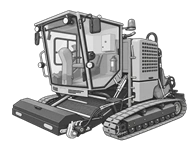
Our beach cleaning machines are suitable for use on coastal areas and beaches within municipal boundaries, public beaches, private beaches, hotels, and holiday resorts. They can also be used for cleaning sand on racecourse tracks, horse and goat farms, and farms with sand-covered ground.
Self-propelled and tractor-towed machines: They are used for cleaning large beaches, coastal areas, and heavily polluted areas that cannot be cleaned efficiently by manual labor.
Walk-behind machines: They are used for daily cleaning of beaches and sandy areas with sun loungers and narrow spaces.
The sand is screened using rotary or vibrating screens. The waste moves along the screens and is collected in the waste hopper.
Compared to manual labor, they complete cleaning in a much shorter time and in a more hygienic and effective way. A cleaning task that would take several people an entire day can be completed by these machines in just a few hours.
The cleaning capacity varies depending on the machine model, size, and beach conditions. They can clean approximately 2,500 m² per hour with walk-behind models and up to 25,000 m² per hour with self-propelled and tractor-towed machines.
The machines can clean dry sand more effectively and quickly.
Foreign materials are collected in the machine’s 1.2 m³ waste hopper. The hopper can be lifted hydraulically and emptied into a suitable waste collection area. The specified discharge height of the system is 225 cm.
Although this varies depending on the screen mesh size, the machines can separate from the sand any materials that can be filtered by the screens. Small and large waste such as cigarette butts, glass and metal pieces, plastic bottles and plastic waste, mussel shells, seaweed, wood and branch pieces can be easily removed with these machines. Depending on the model specifications, it is possible to collect smaller or larger waste materials.
The screening process is automatic on all models. Manual adjustments can be made when necessary.
Beach cleaning machines can clean at different depths depending on the model and operating settings. Walk-behind machines can clean up to 15 cm deep, while tractor-towed or self-propelled machines can reach depths of up to 25 cm. Thanks to the adjustable working depth, not only surface waste but also foreign materials buried beneath the sand can be collected. This provides a more comprehensive sand cleaning process rather than surface cleaning alone.
The sand screening system operates with a special screen or conveyor screening mechanism. As the machine moves, sand and waste are collected into the intake section. The screening system separates the sand and returns the clean sand to the beach, while foreign materials are transferred to a separate collection hopper. This system provides a fast and efficient cleaning process. Walk-behind machines use vibrating screens for the screening process.
Beach cleaning machines have different operating systems depending on the model. Some models offer operator-controlled manual operation, while many models operate with hydraulic-assisted or semi-automatic systems. In advanced models, the waste collection, screening, and unloading processes are designed to reduce the need for operator intervention.

Expert Manufacturer in Beach Cleaning Technologies
Since 1989, Batman Makine has been developing professional beach cleaning solutions backed by decades of experience in machinery manufacturing. We design and manufacture our machines in-house and support our customers with reliable after-sales service.
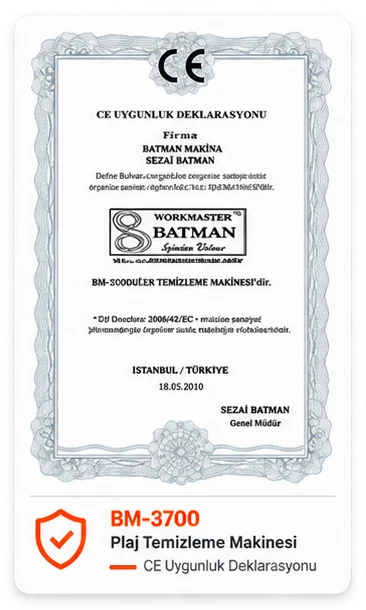
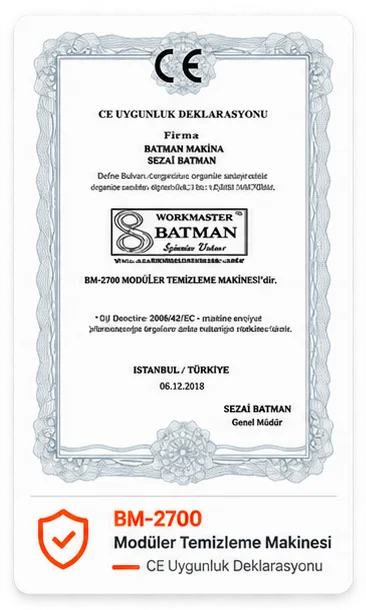
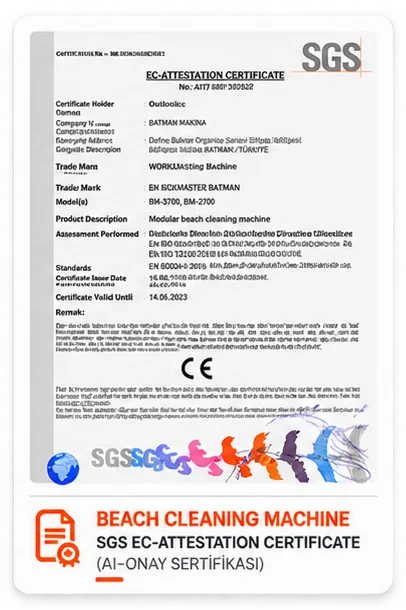
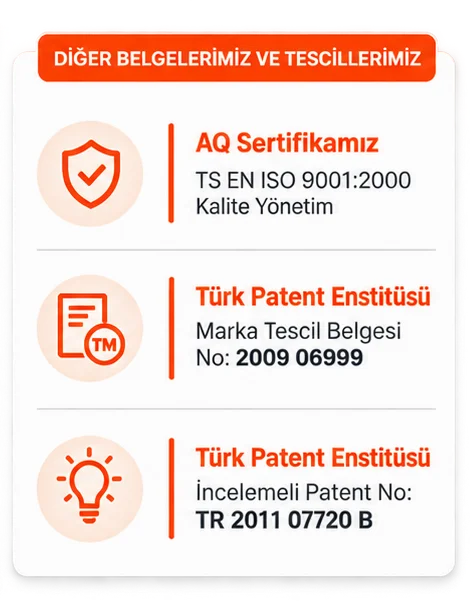
Our Certifications
Explore our certifications, compliance documents, trademark registrations, and patents that reflect our commitment to quality, safety, and manufacturing standards.